One of the most fascinating predictions of Einstein’s theory of relativity is that time does not flow at the same rate everywhere. The idea, known as time dilation, tells us that time moves differently depending on how fast you are traveling or how strong gravity is in the place you are standing. For decades, this has been the subject of thought experiments, but today we have measurements that prove it happens, even here on Earth.
The Global Positioning System is a good example. Satellites orbiting above Earth experience less gravity than we do on the surface. Because of this, their onboard clocks tick slightly faster than clocks on the ground. Without adjustments, GPS systems would drift by several kilometers every day. The difference is tiny, measured in billionths of a second, but it shows that time dilation is a real effect that impacts our technology.
The bigger question is whether time dilation could be felt on the scale of everyday life. At Earth’s horizon, meaning the edge of our planet as seen from orbit, the difference in gravity is not strong enough to slow or speed time in a way humans could notice. For us to feel time slowing in a dramatic way, we would need to be much closer to an object with extreme gravity, like a black hole. Movies such as Interstellar have popularized this idea by showing astronauts experiencing hours while years pass for those farther away. That scenario is extreme but not impossible in the laws of physics.
Still, Earth does provide smaller opportunities to study the effect. In fact, scientists have shown that people living in cities at higher altitudes age slightly faster than those living at sea level, though the difference is so small it would never be noticed without atomic clocks. At the scale of human experience, Earth’s gravity does not distort time in any meaningful way.
What is exciting is how these principles might apply in the future. If humans build large-scale orbital stations or travel to planets with stronger gravity than Earth, the way we experience time could shift. For astronauts traveling at near-light speeds, time would pass differently compared to those who remained on Earth. What feels like a few years to the travelers could be decades on the ground.
This possibility raises questions about communication, family, and human connections. Would spacefarers be able to keep ties with people on Earth if time moved at different rates? Would humanity split into those who experience life in normal time and those whose clocks run differently?
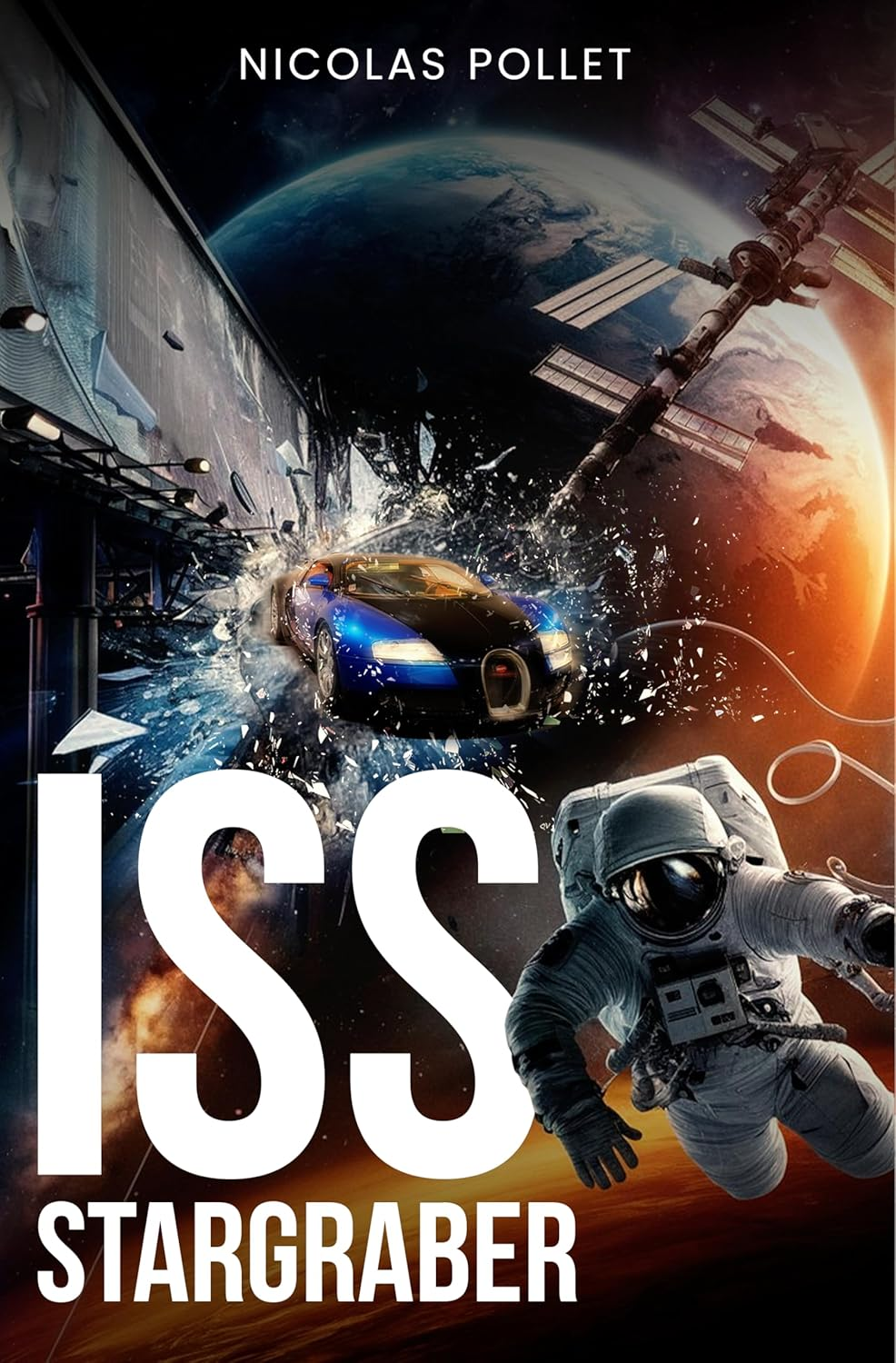
In light of this, science fiction often explores these ideas to highlight the limits of human understanding. Nicolas Pollet’s ISS Stargraber does not focus on time dilation, but it does raise equally big questions about what happens when humanity builds massive orbital stations. The ISS Stargraber is imagined as a 25,000-mile ring around Earth, and while time there would flow nearly the same as on the ground, the challenges of living and surviving in orbit would still reshape human life. For readers who enjoy thinking about the future of humanity in space and the scientific puzzles it raises, ISS Stargraber offers a gripping and thought-provoking story worth exploring. In short, if you enjoy science and looking forwards to the possibility of colonization in space, this book will prove to be an amazing read.
Moreover, with rich themes and a fresh take on the science-fiction genre, this book will take you to places you have never been and will keep you hooked until the very end. So, take a seat and get ready for the most thrilling ride to space… it might leave you awe-struck.
Head to Amazon to purchase your copy: https://www.amazon.com/dp/B0F56P7XVR.