Science fiction has always been a testing ground for ideas that seem impossible, until they are not. From submarines in “Twenty Thousand Leagues Under the Sea” to satellites in “2001: A Space Odyssey,”many inventions once imagined on the page later became part of real life. Nicolas Pollet’s ISS Stargraber adds another bold concept to that list: a colossal orbital station encircling Earth and transferring limitless solar energy back to the planet. It is an extraordinary vision, but could something like the Stargraber Station actually exist?
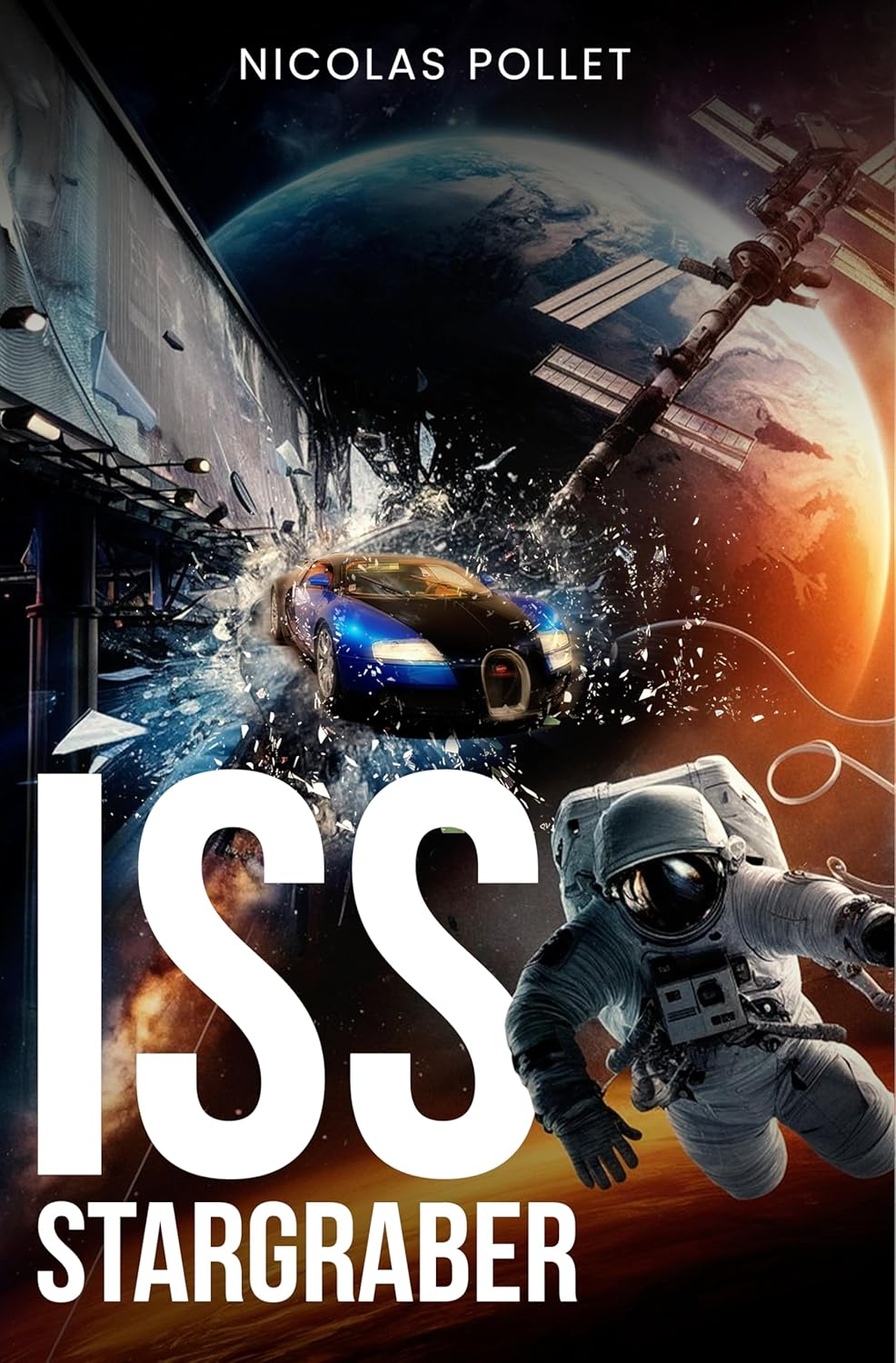
In Pollet’s novel, the Stargraber Geo Orbital Station stretches around half of the Earth’s circumference, made up of thousands of interconnected modules. Each section is equipped with massive solar panels that continuously collect sunlight and channel it to Earth using advanced transmission systems. The result is a clean, constant, and unlimited source of power, a dream for a planet struggling with energy scarcity. It is a captivating concept, but it also raises an intriguing question about the boundaries of science and engineering. How close are we to building something like it?
In truth, parts of the Stargraber’s design are not as far-fetched as they might seem. Scientists have already explored the idea of space-based solar power (SBSP) for decades. The concept involves placing solar collectors in orbit, where they can absorb sunlight without interference from weather or darkness, and then beam that energy down to Earth using microwaves or lasers. Agencies like NASA and JAXA (Japan’s Aerospace Exploration Agency) have conducted experiments that prove wireless power transmission is possible, although scaling it up to a global level remains a challenge.
The most ambitious part of Pollet’s vision is the station’s size and structure. The Stargraber isn’t a simple satellite. It is a massive ring encircling the planet. While no technology today could build something of that scale, several real-world ideas come close. The concept of a “space elevator,” for example, proposes connecting Earth to orbit using a cable made from materials like carbon nanotubes or graphene, allowing for cheaper and more efficient access to space. Meanwhile, megastructure concepts such as Dyson spheres, hypothetical networks of satellites capturing a star’s energy, show that scientists are already thinking about energy systems on a planetary scale.
Still, even if the materials and energy systems could be developed, building something like the Stargraber would require international cooperation on a level never seen before. The logistics of constructing, maintaining, and powering a 25,000-mile orbital structure would make today’s International Space Station seem like a prototype. Political, financial, and ethical questions would also arise: who would own the technology, and who would control the power it provides?
These are the same questions Pollet explores in ISS Stargraber. His story is not just about engineering. It is about humanity’s ability to handle innovation responsibly. The station represents both the best and worst of human ambition: the dream of progress and the temptation of control.
While a real Stargraber Station might still be centuries away, the science behind it is already taking shape. And as history shows, today’s fiction often becomes tomorrow’s fact. For readers who enjoy exploring where imagination meets possibility, Nicolas Pollet’s ISS Stargraber is a fascinating look at how far human ingenuity might one day reach, and the moral choices that will shape that journey.
Get your copies from Amazon: https://www.amazon.com/dp/1967963231.