Imagine a future Earth. Here, a network of orbiting modules spanning 25,000 miles gathers solar energy and supports life on Earth.
This monumental vision becomes a reality in Nicolas Pollet’s ISS Stargraber, pushing the boundaries of human imagination and technological ambition.
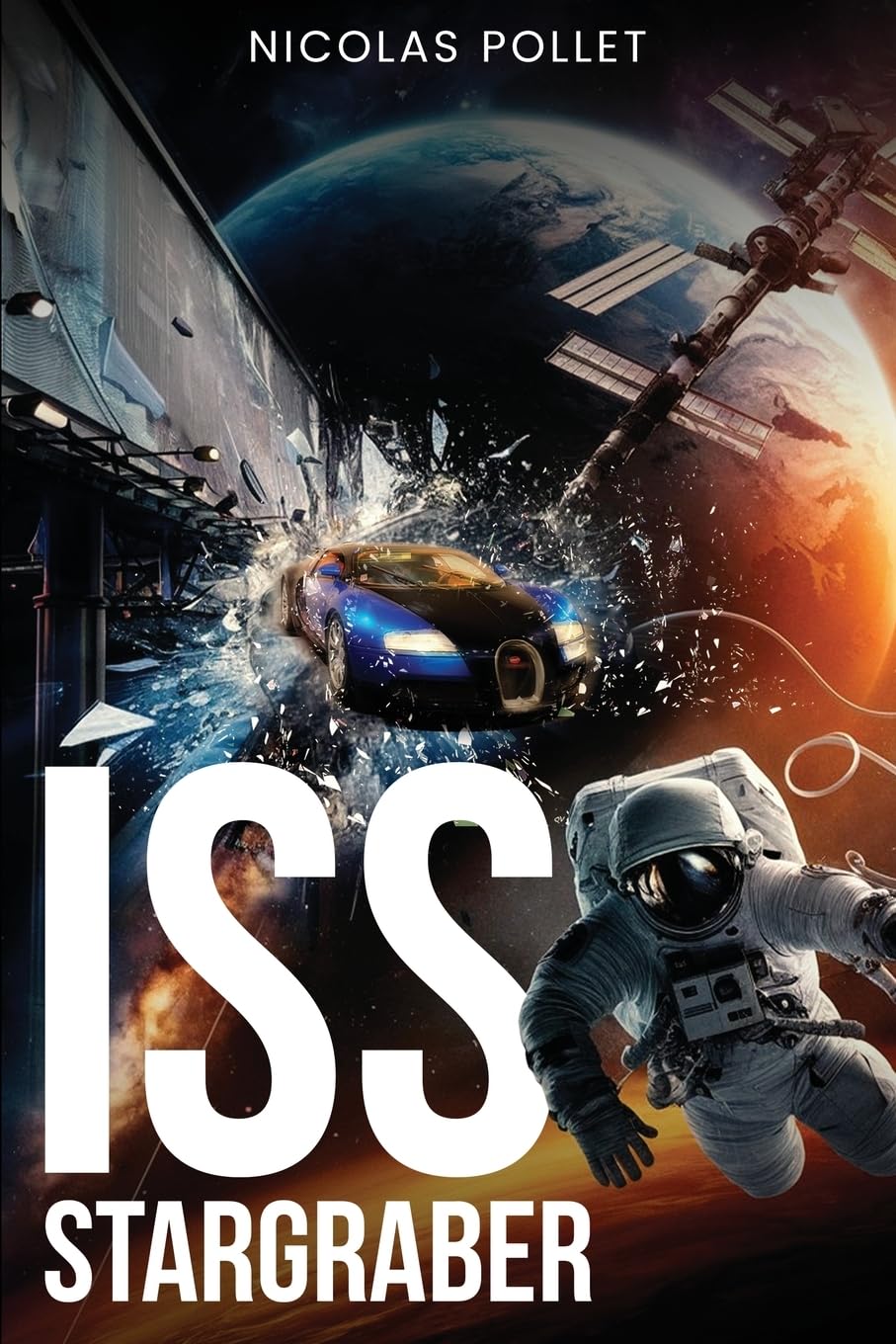
The International Space Station (ISS) is our most impressive orbital achievement to date. It is a multinational collaborative effort between NASA, Roscosmos, ESA, JAXA, and CSA. Spanning about 357 feet end to end and weighing roughly 420,000 kg, the ISS was assembled piece by piece in orbit throughout more than 30 missions. It supports life in low Earth orbit (LEO) and has continuously hosted humans since 2000.
To build something of such massive scale in orbit, we would need lightweight and ultra-strong materials. Traditional alloys wouldn’t suffice. Metallic glass, graphene composites, and carbon nanotubes are examples of next-generation materials that can withstand extreme strain while still being surprisingly light. Though still in experimental phases, these materials are being explored for space elevators, satellites, and aerospace components.
In ISS Stargraber, the station functions primarily as a space-based solar power system. While the concept might sound futuristic, researchers have pursued it since the 1970s. Space solar power (SSP) involves satellites that collect solar radiation and beam it back to Earth as microwaves or laser energy. The advantage is that solar energy in space is constant, unlike Earth-based systems affected by weather and nightfall.
Japan’s space agency JAXA, China’s CNSA, and the U.S. Department of Defense have already launched pilot programs to test microwave-based energy transmission. With focused investment, this technology could scale dramatically in the coming decades.
A standout feature in ISS Stargraber is the concept of “one-legged modules.” These are space elevators that carry people and cargo to orbit. This idea was introduced by Russian scientist Konstantin Tsiolkovsky in 1895. While we lack the materials to build such tethers today, the ongoing development of ultra-strong polymers and nanotube cables brings this dream to reality.
A functioning space elevator would revolutionize space logistics. It could drastically reduce the cost of delivering materials to orbit and make the construction of massive infrastructure like Stargraber viable.
ISS Stargraber also introduces concepts like adaptive gravity fields and shielding against space debris. While artificial gravity remains theoretical, concepts using centrifugal force, magnetic levitation, or inertial dampening are being studied in labs and simulations.
As for protection against micrometeoroids, spacecraft already use Whipple shields. These shields disperse impact energy across layers. In the future, long orbital chains might be protected by more sophisticated forms of this shielding, possibly utilizing electromagnetic fields or adaptable materials.
A less technical but no less important prerequisite is international political will. ISS Stargraber imagines a future where nations unite around a common purpose. This reflects the spirit of today’s ISS, which has remained a beacon of cooperation even amid geopolitical tensions.
Autonomous AI systems would also be needed to manage energy flow, repair systems, navigation, and provide life support. From the Hubble telescope to the Mars rovers, artificial intelligence is already a part of current space missions. They have the potential to manage entire infrastructures like Stargraber in the future.
For now, building something like ISS Stargraber would require unprecedented levels of cooperation, innovation, and perseverance. But it’s not impossible. As Nicolas Pollet shows in ISS Stargraber, his concept may be the blueprint for tomorrow’s greatest engineering marvels.
Can we make this vision possible? Read the book to find out. https://www.amazon.com/dp/B0F56P7XVR.