It’s not often that a sci-fi novel manages to feel both vast and deeply personal. But Nicolas Pollet’s ISS Stargraber pulls off that rare feat. It’s a slow-burning, character-driven thriller set in one of the most ambitious fictional settings in the future, on a space station so enormous that it wraps around the entire Earth, circling it, similar to the rings of Saturn.
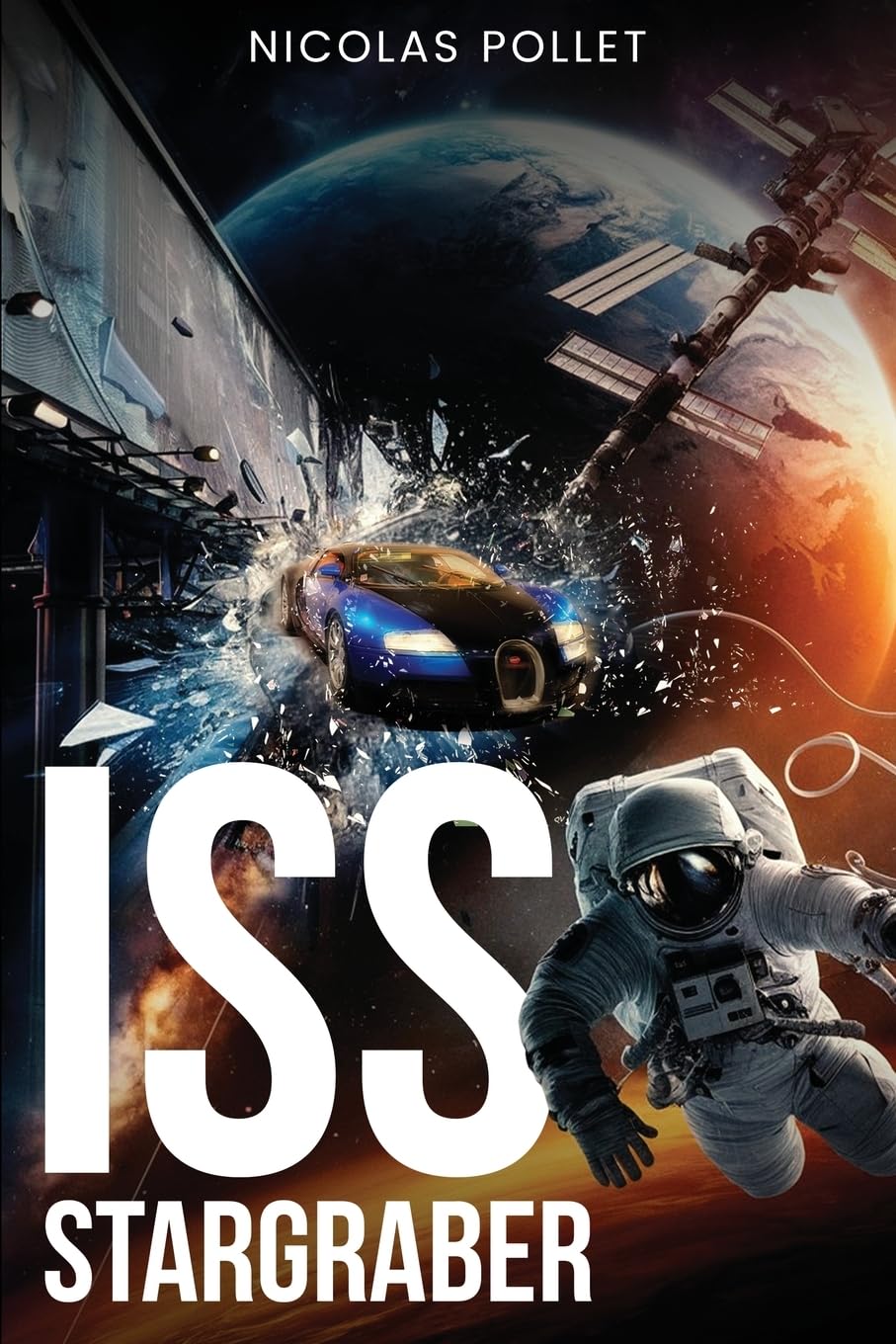
Stargraber, the titular orbital station, is humanity’s greatest invention. It is a self-sustaining megastructure collecting and transmitting solar energy to the Earth below. In doing so, it has solved the world’s energy crisis and ushered in an era of apparent harmony. But beneath the glass-and-steel perfection of this future lies an uncomfortable truth: all it takes is one person, one system failure, to bring the whole thing down.
When the story begins, Stargraber seems calm. John Desmond, the station’s head of security, is quietly enduring a life he never asked for. He was reluctant to come to Stargraber because a personal tragedy was haunting him at every turn. He didn’t want to live among polished modules and political games. But after his wife’s death, orbit seemed like the only place far enough from pain.
Then someone sabotages a critical system. A friend is injured. Desmond investigates. And the real story begins.
This is not a shootout-in-space kind of sci-fi. ISS Stargraber is a cerebral, intricate thriller. The tension doesn’t come from explosions (though there are some). It comes from slow discoveries, hushed conversations, and veiled threats, likewise any good and intense crime thriller.
What’s so compelling is the emotional intelligence of the book. Desmond’s grief is written with restraint, but it colors everything he does. His interactions with his co-investigator, a brilliant and sharp-witted geochemist, add layers of connection, conflict, and humanity that ground the novel’s grand scale.
The world-building is immersive. But it is never overwhelming. Pollet gives us enough detail to understand the station’s design, function, and complexity. He doesn’t bog down the narrative in exposition. Every piece of tech feels plausible. Every political nuance matters, and with every other turn, you will only get to witness something amazing that will chill your blood.
The mystery at the core of the book is gripping. John Desmond must outsmart the person causing the station’s disruption. He must discover the reason. Does it have an ideology? Revenge? Or something deeper? As the plot unfolds, readers are forced to ask themselves whether the very things we build to protect us might one day betray us.
ISS Stargraber will appeal to readers who love thoughtful science fiction or stories that balance technological wonder with very human flaws. It’s part political thriller, part emotional drama, and entirely addictive. It is a work of near-future fiction that dares to envision a time when humans will be able to live in the sky.
If you’re looking for a smart, mature, and utterly compelling read, ISS Stargraber deserves a place on your shelf. It might just change the way you think about progress, systems, and survival.
Order your copy on Amazon: https://www.amazon.com/dp/B0F56P7XVR.