There’s something uniquely terrifying about what we don’t understand.
In 2025, dark matter remains one of the biggest mysteries in modern astrophysics. We know that it covers almost 85% of our universe’s total mass, which is known to us. We know that it doesn’t reflect light. It doesn’t emit energy. We can’t see it. We can only measure its gravitational pull. Like a ghost in the cosmos, it affects the motion of galaxies and the structure of the universe, but we don’t know what it is and how it is causing this massive pull.
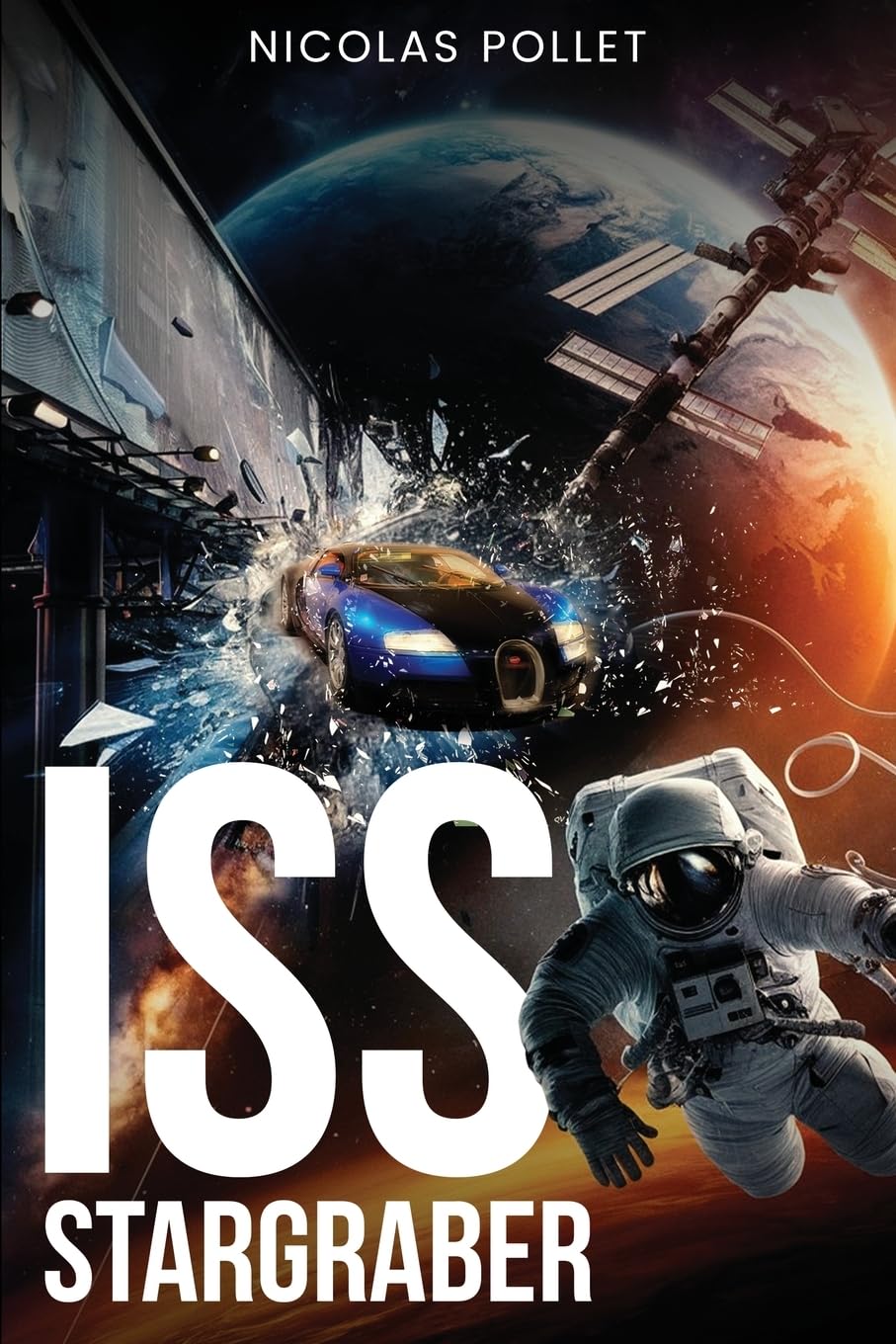
This fundamental unknown has become the perfect canvas for science fiction. It embodies the essence of what makes sci-fi suspenseful: the fear of the invisible.
Nicolas Pollet’s ISS Stargraber isn’t about dark matter explicitly. But it channels that same terrifying ambiguity through its structure, tone, and narrative mystery. At the heart of the story lies a seemingly perfect world: Earth is powered by an orbital ring, the Stargraber Station. Technology is stable. Society is thriving. But something is off. Systems are breaking down. Accidents are too precise. Someone is manipulating things, but from where?
And why?
Like the gravitational pull of dark matter, the antagonist in ISS Stargraber isn’t known. Readers, like protagonist John Desmond, begin to sense a force bending reality. Conversations feel off. Security logs don’t match. Nothing adds up. And yet the evidence is intangible, like space itself hiding a hand that’s reshaping everything.
The novel’s genius is that it never treats science fiction as spectacle. It treats it as a mystery. And in doing so, it mirrors modern scientific curiosity. Just as researchers at CERN and NASA continue to probe the edges of physics, Desmond probes the edges of human behavior, institutional power, and the limits of trust.
This connection between the mysteries of the cosmos and the threats in fiction is not coincidental. In stories like Annihilation or Interstellar, the real fear isn’t what we can fight. It is what we can’t even define. ISS Stargraber takes this principle and roots it in technology: the terrifying idea that the systems meant to save us might conceal truths too dangerous to name.
As Earth stares into the dark unknown, both literally and metaphorically, our fiction evolves to reflect our unease. The idea that something, somewhere, is shaping reality in ways we don’t fully grasp is no longer a fantasy. It’s science with a countdown.
And like dark matter itself, ISS Stargraber leaves a trace in your mind. This bull will pull at the edges of certainty, bending your sense of what’s safe, what’s secure, and what’s truly holding our world together.
Read it. Then look up. What you can’t see may be the most dangerous thing of all.
Order your copy on Amazon: https://www.amazon.com/dp/B0F56P7XVR.