Disclaimer: The passage below is an original creative excerpt inspired by ISS Stargraber and written only to introduce this review.
John Desmond had seen the ISS Stargraber from every possible angle, but tonight it felt different. The lights along the station’s outer ring flickered for a moment, a brief pulse that no one else seemed to notice. He froze, his hand suspended above the security console. Systems this large did not blink. Not without reason. Somewhere across the twenty five thousand miles of cables and modules, something was out of place. Something small. Something deliberate.
A soft alarm chimed, barely audible, like the station was whispering a warning only he could hear. The report on his screen made no sense. A minor fault, harmless on its own, but located in a section that should have been impossible to access without clearance. The system refreshed. Unauthorized presence detected. Yet according to the logs, no one was there.
Before John could alert anyone, the lights flickered again. This time, the console went dark. Something had begun, and he already felt one step behind.
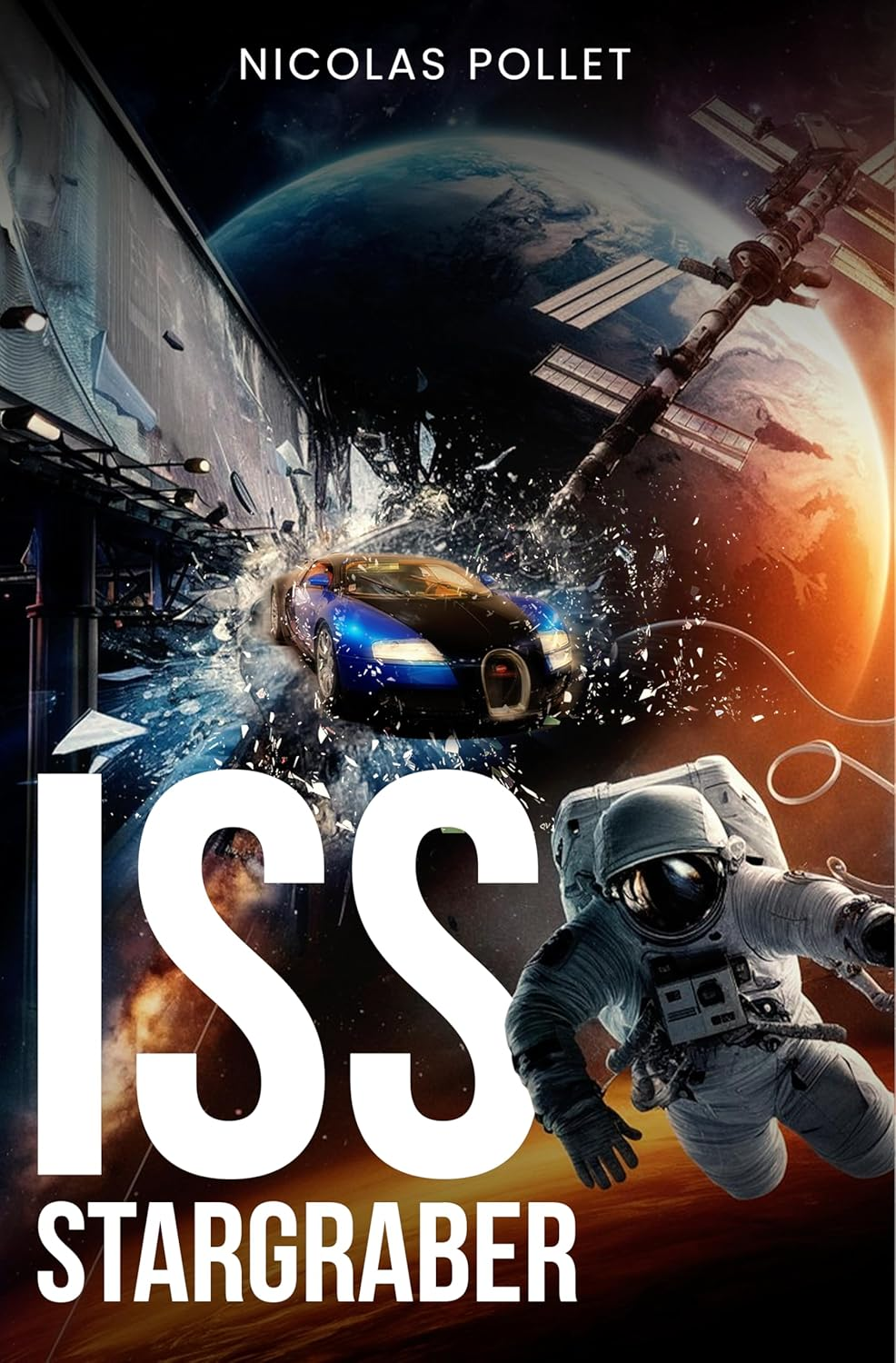
There are stories that rely on loud explosions and endless action to keep readers hooked, and then there are stories like ISS Stargraber by Nicolas Pollet, where the tension builds quietly, almost silently, until the pressure becomes impossible to ignore. From the very first chapters, the novel pulls readers into a future where Earth has placed its hope in a colossal orbital structure designed to power the planet. It is a symbol of success, cooperation, and survival. Yet it is also a reminder that even the greatest human achievements are only as strong as the people protecting them.
At the heart of the story is John Desmond, whose life is shaped by loss and responsibility. He serves as the head of security aboard Stargraber, a role that requires calm thinking, clear judgment, and an understanding of how fragile life in orbit can be. Pollet does a strong job grounding John. He is not a superhero or a flawless commander. He is a human being who must balance instincts, doubt, and duty while facing events far larger than himself.
The world around him is equally engaging. The Stargraber itself is more than a setting. It is a functioning system with thousands of interconnected parts. Power grids, energy cables, rotating rings, housing sectors, and scientific modules all work together to keep life going on Earth. The station feels real because Pollet focuses on function rather than spectacle. Readers can understand how things work, which makes it easier to understand how they can fail.
As the story unfolds, the failures feel small at first. A glitch here. A signal there. But the strength of the book lies in how these small cracks form the beginning of something far more dangerous. It becomes clear that someone is interfering with the systems that power Earth, and the sense of rising danger is steady and controlled rather than rushed.
Victoria, the geochemist who works closely with John, adds balance to the narrative. She is analytical, observant, and not afraid to challenge assumptions. Their partnership brings emotional depth to the plot without overpowering the story’s central focus on the unfolding crisis. Their investigation becomes the heart of the novel as the pieces of the conspiracy slowly come together.
One of the strongest qualities of ISS Stargraber is its grounded approach to science. The technologies described in the story are believable and in some cases already in development today, such as large-scale solar collection systems, extended orbital habitats, and global energy transfer. This realism makes the threat feel even sharper, because the events in the book do not seem so far removed from what our world might face someday.
The pacing remains steady throughout. Every answer creates a new question. Every breakthrough reveals a new risk. And just when the reader thinks they understand the scope of the threat, the story widens its reach. By the time the bigger picture comes into view, both John and the reader are already deeply immersed in the conflict.
ISS Stargraber succeeds because it never forgets that suspense comes from uncertainty. The danger arises not from the spectacle itself, but from the fear of the unknown and the limits of control in an environment where even a minor mistake can turn deadly.
For readers who enjoy grounded science fiction, political tension, human-driven stories, and mysteries that unfold in layers, ISS Stargraber delivers a well-balanced and engaging experience.
Get your copies from Amazon: https://www.amazon.com/dp/1967963231.