Imagine a glittering chain of modules encircling Earth that powers the planet with limitless clean energy. In Nicolas Pollet’s ISS Stargraber, the Stargraber Geo Orbital Station is exactly that. It is a colossal, 25,000-mile-long megastructure that dwarfs today’s space stations and redefines humanity’s place in the cosmos. Set in year 2153, this sci-fi thriller paints a vivid picture of a future where orbital habitats host experiments and sustain life on Earth itself, which invites us to ponder: could such a destiny be plausible?
The Stargraber, described as a “string of giant sausages” with solar-panel-covered modules and space elevators, is a leap beyond our current orbital outposts. Today’s International Space Station (ISS), a collaboration among NASA, ESA, and others, spans roughly the size of a football field and supports crews of six for scientific research. China’s Tiangong, a newer modular station, aims for similar goals with a focus on autonomy. Both are marvels, but they’re modest compared to Pollet’s creation, which houses 10 million people and powers Earth via solar energy beamed from space.
Stargraber’s scale echoes speculative designs like the O’Neill cylinders—massive rotating habitats—yet grounds itself in technologies we’re already exploring.
One of Stargraber’s boldest features is its role as an energy hub. Its photovoltaic panels, free from atmospheric interference, capture solar power 24/7. Japan’s JAXA has studied space-based solar power since the 1980s, aiming to beam energy via microwaves to Earth. NASA’s recent experiments with solar arrays on the ISS hint at this potential, though scaling up remains a challenge. Pollet’s vision assumes breakthroughs in efficiency and transmission, as it imagines a world where fossil fuels are obsolete, hunger is eradicated, and nations unite under a shared energy grid. It’s a utopian dream with a dark edge, as the novel’s plot reveals threats to this delicate balance.
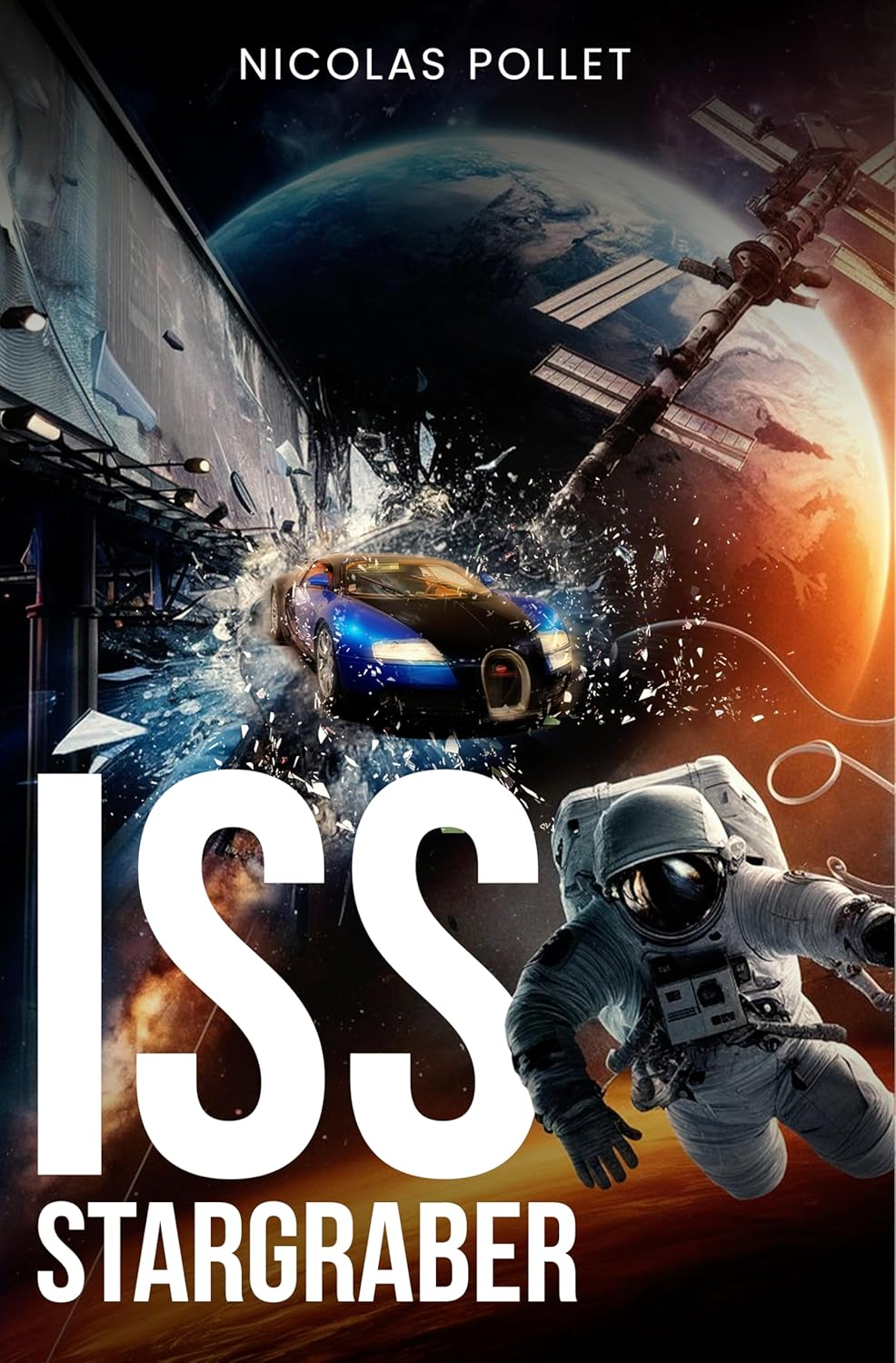
Then there are the “one-legged modules.” They are space elevators that use 31,000 miles of nanotube cables to transport people and products into orbit. While still theoretical, companies like Obayashi Corporation have proposed carbon-nanotube-based elevators by 2050, and Pollet extrapolates this into a network stabilizing Stargraber’s orbit. Compare this to NASA’s Lunar Gateway, a planned outpost for Artemis missions, which will serve as a staging point for lunar and Martian exploration. SpaceX’s Starship, designed for reusable interplanetary travel, further blurs the line between fiction and reality, suggesting that Pollet’s megastructure isn’t as far-fetched as it seems.
What makes ISS Stargraber compelling is how it weaves these innovations into a human story. The station is a technological marvel. It is a fragile ecosystem where 10 million “space submariners” live, work, and face existential threats. While fictional, Pollet’s narrative asks whether such a structure could unify humanity or become its Achilles’ heel? As SpaceX, Blue Origin, and global agencies push boundaries, Stargraber feels like a glimpse of what’s possible if we dare to dream big.
For sci-fi fans, ISS Stargraber offers a thrilling ride through a plausible future, while tech enthusiasts will geek out over its grounded speculation. Could we build a Stargraber? Maybe not today. But with the ever-growing technology and latest breakthroughs in science, we might be able to build it tomorrow. With advancements in solar tech, materials science, and orbital infrastructure, Pollet’s vision might just be humanity’s next giant leap.
For more inspiration and to explore Stargraber in detail, please read ISS Stargraber. Grab your copy on Amazon: