Every leap in human history has come from adaptation. From learning to use fire to building machines that reach the stars, survival has always depended on our ability to change. But as technology begins to redefine what it means to be human, the next stage of evolution may no longer be physical. It may be mental and moral. Nicolas Pollet’s ISS Stargraber explores this shift in a deeply human way, asking not what we can become, but what we must become to survive our own creations.
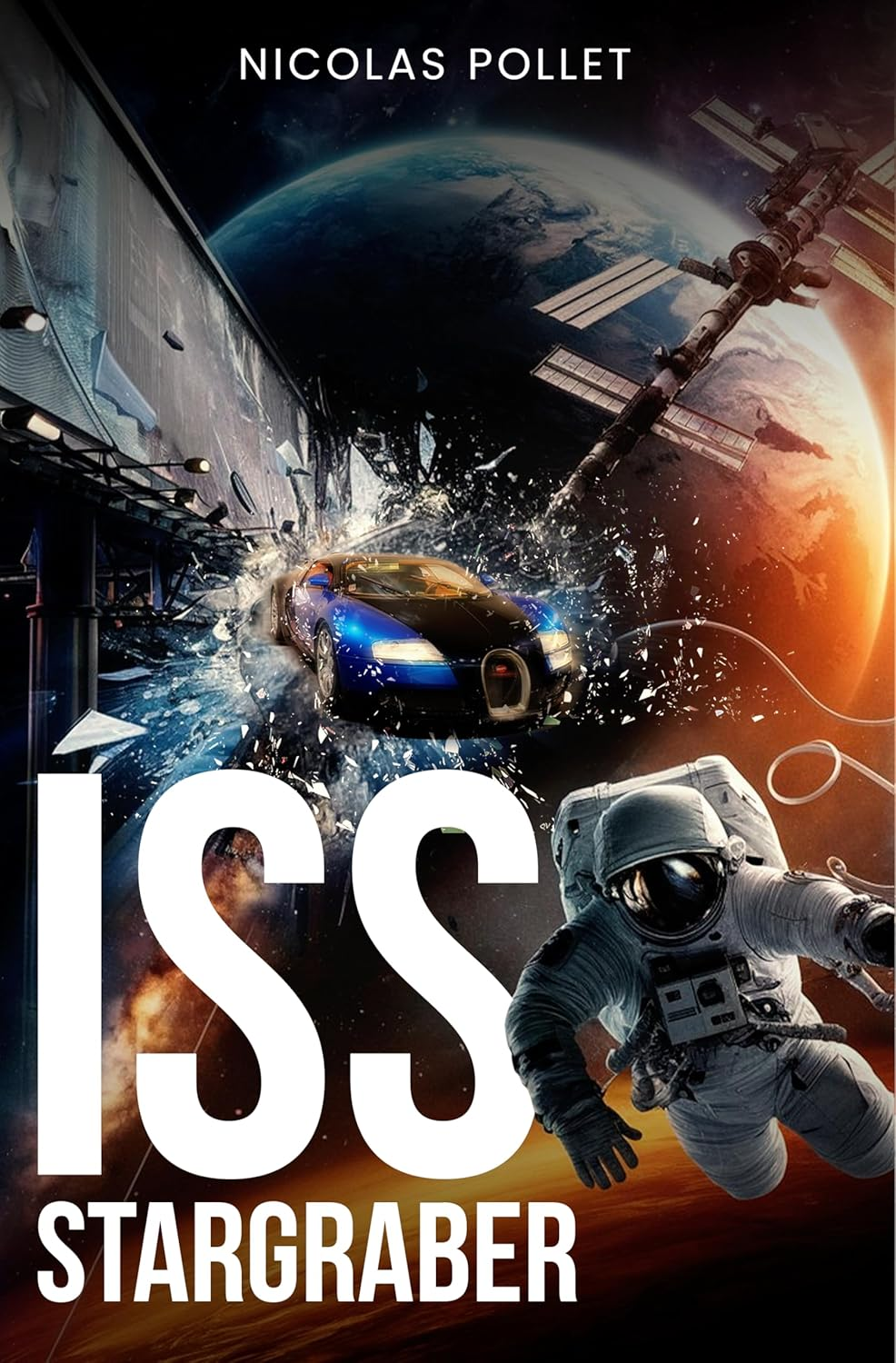
Set in a future where Earth’s energy crisis has been solved through an enormous orbital station, ISS Stargraber captures the moment when humanity steps beyond the planet that gave it life. The station, circling the Earth like a shining crown, harnesses unlimited solar energy to sustain civilization below. It is the ultimate symbol of progress, proof that humans can master their environment on a global scale. But within this triumph lies the story’s central question: if technology can save us from extinction, can it also strip away what makes us human?
Pollet’s vision of evolution is not about developing new physical abilities or merging with machines. It is about moral and emotional adaptation. His characters, led by the flawed yet courageous John Desmond and the determined engineer Victoria Palmers, are forced to face a world where intelligence is no longer enough. On the Stargraber Station, progress has outpaced conscience. The line between human and machine, creator and creation, has blurred. The next phase of evolution, Pollet suggests, will depend on whether humanity can balance its knowledge with empathy, restraint, and ethical clarity.
This idea feels especially relevant in our own time. As artificial intelligence, genetic engineering, and automation continue to grow, we are already reshaping ourselves in ways no previous generation could have imagined. However, while we can design smarter machines and extend human life, we have not evolved emotionally at the same pace. Conflict, greed, and fear continue to influence much of our behavior. ISS Stargraber magnifies this truth by placing its characters in an environment where survival depends not on strength, but on cooperation and moral courage.
The novel also touches on physical adaptation. Living in orbit changes more than daily routines; it changes identity. The inhabitants of the Stargraber Station are pioneers of a new existence, separated from Earth’s natural rhythms and rules. They must learn to think differently, act differently, and redefine what “home” means when the planet is no longer beneath their feet. Through this, Pollet captures both the wonder and the loneliness of progress. Evolution, he reminds us, is not just about advancement. It is about loss as well.
Ultimately, ISS Stargraber reimagines human evolution as a test of character rather than biology. The story shows that the future will not belong to those with the most advanced machines, but to those who learn to wield them wisely. Actual progress will come when humanity evolves not just in technology, but in understanding.
For readers who enjoy science fiction grounded in truth and emotion, ISS Stargraber by Nicolas Pollet offers a powerful reflection on what it means to grow, adapt, and remain human in an age of boundless innovation. It reminds us that the next step in evolution will not be found in the stars, but in ourselves.
Get your copies from Amazon: https://www.amazon.com/dp/1967963231.