Every once in a while, a story comes along that feels bigger than the page. Some books invite you to imagine a quiet world, while others demand sound, light, and scale. Nicolas Pollet’s ISS Stargrabber is one of those books. It is written like a movie unfolding in real time, filled with characters caught in life-or-death stakes, technology that feels believable, and settings that deserve to be seen on the biggest screen possible.
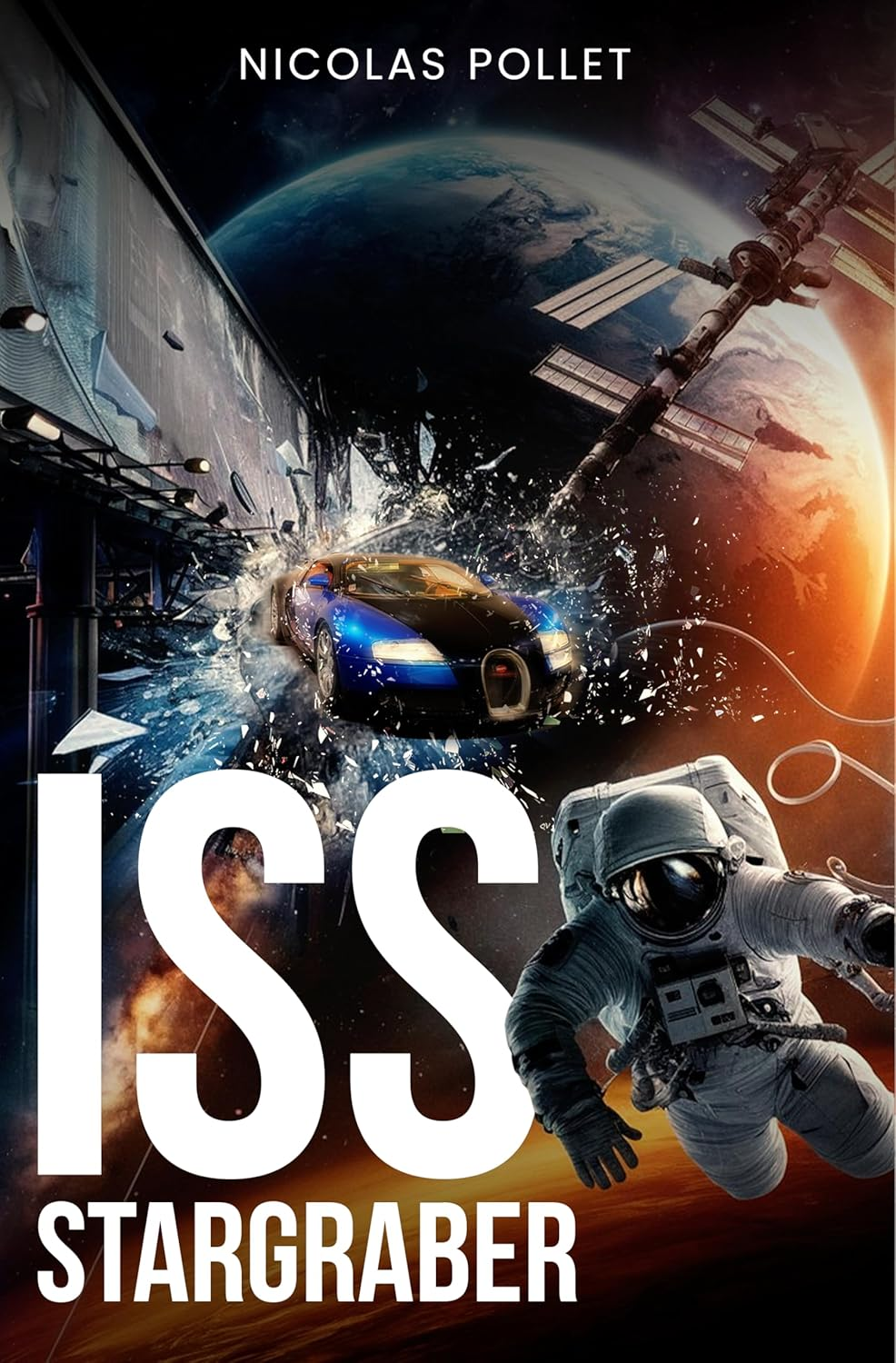
At the heart of this cinematic quality is the setting itself. Stargraber is no ordinary space station. It is a massive orbital structure circling half the Earth, a chain of modules stretching for thousands of miles. Each section is alive with activity, from laboratories to living quarters to colossal space elevators that connect the station to Earth. Reading these descriptions feels like watching a sweeping establishing shot in a film, where the camera pans across an impossible but believable world. The detail Pollet builds into the station makes you want to see it realized with visuals, sound, and scale.
But a blockbuster is never just about the background. It is about people and the choices they make. ISS Stargrabber gives us John Desmond, a man scarred by grief, who becomes an unlikely protector. His pain and guilt are personal, yet they shape every decision he makes. This makes him a character audiences would root for on screen. Viewers would see not just the action but also the emotion that drives it. Alongside him is Victoria Palmers, a miner from Earth who brings her own resilience and intelligence into the fight. Together, their unlikely partnership feels tailor-made for the kind of character chemistry audiences love in great films.
Action sequences in the book also read like they were written with film in mind. Whether it is a high-speed crash on Earth, sabotage in the corridors of the station, or desperate attempts to stop disasters in space, the scenes are paced tightly and carry a visual intensity. You can almost hear the music build, see the flashing alarms, and feel the weightlessness as characters race against time. Each chapter seems to set up another scene that would keep audiences glued to their seats.
Another reason the book feels ready for the screen is the way it mixes spectacle with suspense. Blockbuster films succeed when the tension builds not just from explosions or battles but from the uncertainty of who can be trusted and what is really at stake. Pollet threads a conspiracy through the story that reaches from Earth to orbit, pulling in miners, scientists, and shadowy enemies. This sense of danger lurking beneath the surface gives the story depth, ensuring that a film adaptation would be more than just visual spectacle.
And then there is Yellowstone. Few natural features on Earth carry the same cinematic weight as the Yellowstone supervolcano. By tying it into the plot, Pollet adds a looming sense of dread that audiences would instantly connect with. The thought of one of Earth’s most powerful forces being triggered by human interference is chilling, and on screen it would provide the perfect mix of science, danger, and drama.
In many ways, ISS Stargrabber already reads like a screenplay. The pacing is tight, the chapters end with hooks, and the characters face choices that reveal who they are under pressure. It is the kind of story that could easily move from page to screen without losing its impact.
For readers, the book already delivers the thrill of a blockbuster. But it is hard not to imagine what it would feel like to sit in a theater, lights dimming, as the scale of Stargraber fills the screen. So, are you ready to see it in motion? If the answer is yes, you should read this book and, of course, submit a proposal to turn it into a blockbuster film. Head to Amazon to purchase your copy: https://www.amazon.com/dp/B0F56P7XVR